

Your daily news update on the Middle East
Provided by AGP
Robotaxi Trillion-Dollar Market; But an Unsolved Operations Problem
The Human Side of Autonomous Mobility, by field operator and mobility executive Carlo Iacovini, delivers a direct challenge to the AI-first narrative: as robotaxi volumes surge and safety investigations multiply in the same week, the industry's real bottleneck has never been the algorithm
NEW YORK, May 12, 2026 (GLOBE NEWSWIRE) -- Maxi Mobility, a fleet operations and mobility services company, today announces the publication of The Human Side of Autonomous Mobility by Carlo Iacovini. The book arrives as two things happened simultaneously this week in the American robotaxi industry. Uber reported that autonomous trips on its platform grew tenfold year over year, with CEO Dara Khosrowshahi calling autonomous mobility a 'trillion-dollar total addressable market' on the company's Q1 2026 earnings call. And federal safety regulators opened a new investigation into a robotaxi operator for crashes that NHTSA described as showing 'excessive assertiveness and insufficient competence' — while trained safety supervisors sat on board and did not intervene.
Both things being true at the same time is not a paradox. It is the precise condition that a new book predicted and explains.
The Human Side of Autonomous Mobility by Carlo Iacovini argues that autonomous driving is entering its most critical and least understood phase — one where scaling volume and ensuring operational reliability are in direct tension, and where the gap between technological performance and system-level readiness is becoming impossible to ignore.
"A successful pilot proves that something can work. A scalable service proves that a system can endure."
Iacovini writes from direct field experience, not from analysis. As Managing Director EMEA of an early autonomous vehicle startup, he led teams of engineers and operators on some of the first public autonomous mobility deployments ever attempted — before regulation existed, often before the market was ready. His subsequent work spans fleet operations, charging infrastructure, mobility strategy, and operational design across Europe, the United States, the Middle East, and Australia.
His book arrives at a moment of structural stress in the industry. Goldman Sachs Research projects the global robotaxi market will reach approximately $415 billion by 2035. Uber has committed more than $10 billion to autonomous vehicle partnerships and fleet arrangements. Waymo is targeting one million paid rides per week by year-end. And yet the U.S. still has no federal autonomous vehicle safety law. First responders in multiple cities have become, in the words of Austin public safety officials, 'the default roadside assistance' for stalled and malfunctioning vehicles. The question the industry cannot yet answer is not whether autonomous vehicles can drive. It is whether the system around them is ready to operate.
"The future of autonomous mobility will depend less on who builds the smartest machine, and more on who designs the most credible operating model around it."
Iacovini's argument is structural. He does not dismiss the technology. He identifies the layer that has been systematically underbuilt: the operational infrastructure — depot management, fleet supervision, maintenance systems, regulatory relationships, driver and operator training, and the institutional design needed to ensure that a vehicle that can complete a trip can also handle the conditions when it cannot.
"In a supposedly driverless future, the human factor does not disappear. It becomes more strategic."
The book draws on real deployment stories — including the first autonomous shuttle services for hospital patients in Europe, and a deployment where precision 3D mapping became obsolete because the vegetation along the route changed with the seasons — to illustrate what the industry's press releases do not show: the distance between a vehicle that performs in a demo and a service that endures in daily operation.
It is written for the executives, investors, founders, and policymakers who are now being asked to make billion-dollar decisions in an industry where the operational playbook is still being written.
About the book
The Human Side of Autonomous Mobility by Carlo Iacovini. Published in May 2026. Available on Amazon and major online retailers worldwide. ISBN: 979-12-243-3165-0.
About the author
Carlo Iacovini is an international mobility executive and author. As Managing Director EMEA of an early autonomous vehicle startup, he led the deployment of autonomous technology across Europe, working with teams of engineers and operators on some of the first real-world autonomous mobility services on public roads. He currently serves as COO of Maxi Mobility, a company specialized in fleet operations and mobility services management. His work spans electric mobility, charging infrastructure, fleet operations, and mobility strategy across Europe, the United States, India, the Middle East, and Australia. He is also the author of Car Sharing.
Web: www.ma-xi.it - linkedin.com/in/carloiacovini
Media contact
Email info@carloiacovini.com
A photo accompanying this announcement is available at https://www.globenewswire.com/NewsRoom/AttachmentNg/43a94269-37e5-4e02-a5d2-5bf9cb62ad1b

Cover
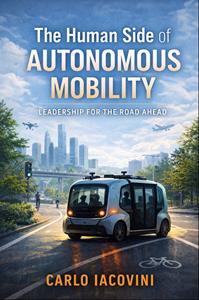
Cover book of The human side of autonomous mobility
Legal Disclaimer:
EIN Presswire provides this news content "as is" without warranty of any kind. We do not accept any responsibility or liability for the accuracy, content, images, videos, licenses, completeness, legality, or reliability of the information contained in this article. If you have any complaints or copyright issues related to this article, kindly contact the author above.
